Modern systems fail where structure is invisible.
Most platforms expose data and metrics, but hide the structural reality underneath:
- Where execution can legally go
- Where authority applies
- Where constraints actually live
- Where guarantees quietly break
When structure is flattened into logs, dashboards, and explanations, failure becomes something you discover after impact.
Terahertz exists to change that.
What is Terahertz?
Terahertz is a structural imaging product that renders running systems as spatial geometry.
Instead of charts or narratives, you see:
- Models as regions of state
- Fields as interfaces and constraint surfaces
- Paths as legal traversal
- Activity and failure as movement, heat, and fracture
It doesn’t explain your system.
It shows you what is structurally true.
Core capabilities.
Structural capabilities Terahertz exposes directly, without abstraction, inference, or interpretation.
Structural rendering
Systems appear as geometry derived from executable structure.
Field-level precision
Constraints, authority, and failure are visible at the interface level.
Executable path tracing
Queries and operations appear as ephemeral structures moving through real paths.
Failure as geometry
Validation errors, denials, probes, and invariant violations have distinct, readable forms.
How Terahertz works.
Nothing is simulated.
Nothing is interpreted.
What you see is instantiated reality.
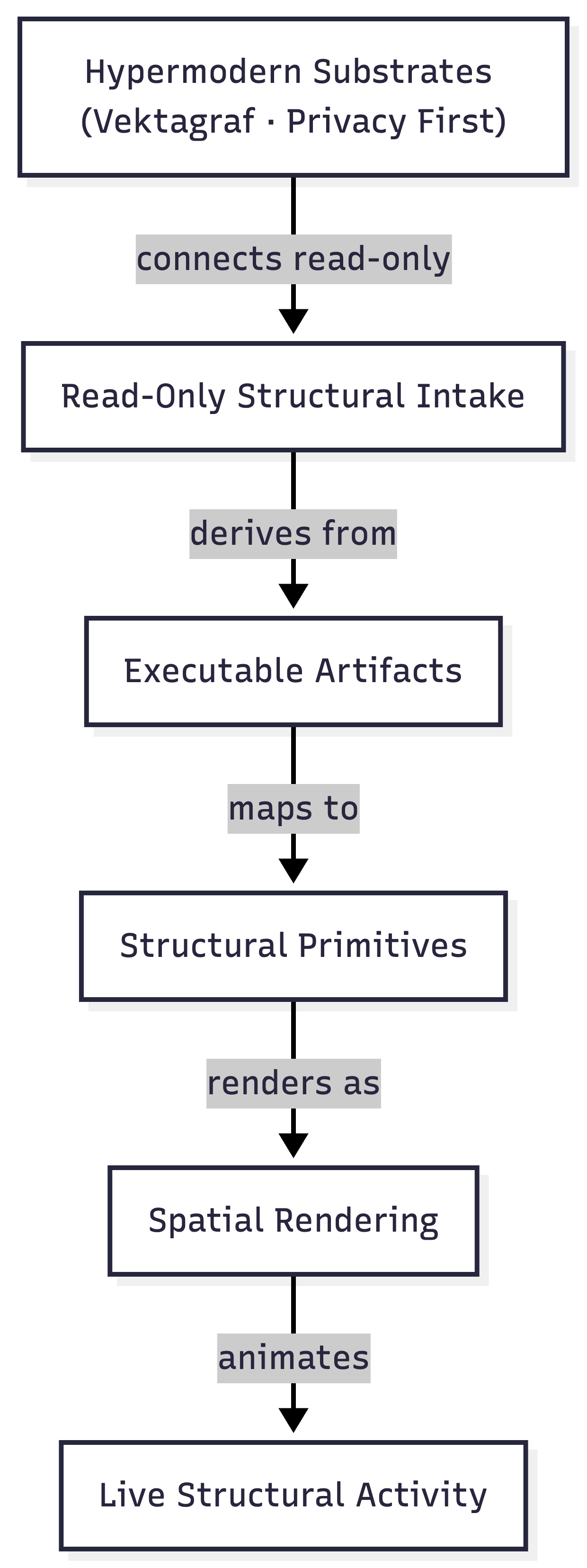
- Terahertz connects read-only to your Hypermodern substrates (Vektagraf and Privacy First).
- Structural primitives are derived directly from executable artifacts, not inferred.
- Models, fields, edges, and events are rendered spatially.
- Execution, enforcement, and failure animate the structure in real time.
What becomes visible.
Where constraints attach, at fields, not abstractions
Which paths execution can and cannot take
How authority scopes collide with attempted actions
Where pressure accumulates before failure
Which guarantees hold and where they fracture
This is not observability.
It is structural visibility.
Built for the Hypermodern stack.
Terahertz is not a general-purpose visualization tool.
It is designed specifically for systems built on:
- Vektagraf — schema, execution, and provenance
- PrivacyFirst — authority, mandates, and consequence boundaries
- Metaspace — systems understood as environments, not workflows
Terahertz does not add structure.
It renders the structure you already have.
Typical use cases.
Examples:
- Exploring complex schemas and relationships
- Understanding why access was denied — structurally
- Identifying where validation pressure accumulates
- Investigating failure without replaying logs
- Teaching teams how their system actually works
No recommendations.
No automation.
Just visibility.
What Terahertz is not.
Terahertz does not:
Act as a control plane
Replace governance or policy systems
Recommend fixes
Explain intent or blame
Tell stories about your system
It shows structure.
Interpretation is up to you.
Current status.
Terahertz is currently in active development as part of the Hypermodern product suite.
The structural imaging model is stable.
Interfaces and interaction layers are evolving.