What Is Codal?
Codal is a structural language designed to make meaning executable.
It allows intent, scope, and constraint to be expressed in a form that machines can enforce and humans can reason about, without interpretation, inference, or post-hoc negotiation.
Codal is not designed to describe systems.
It is designed to bind them.
The problem.
Modern systems are built on language that cannot execute.
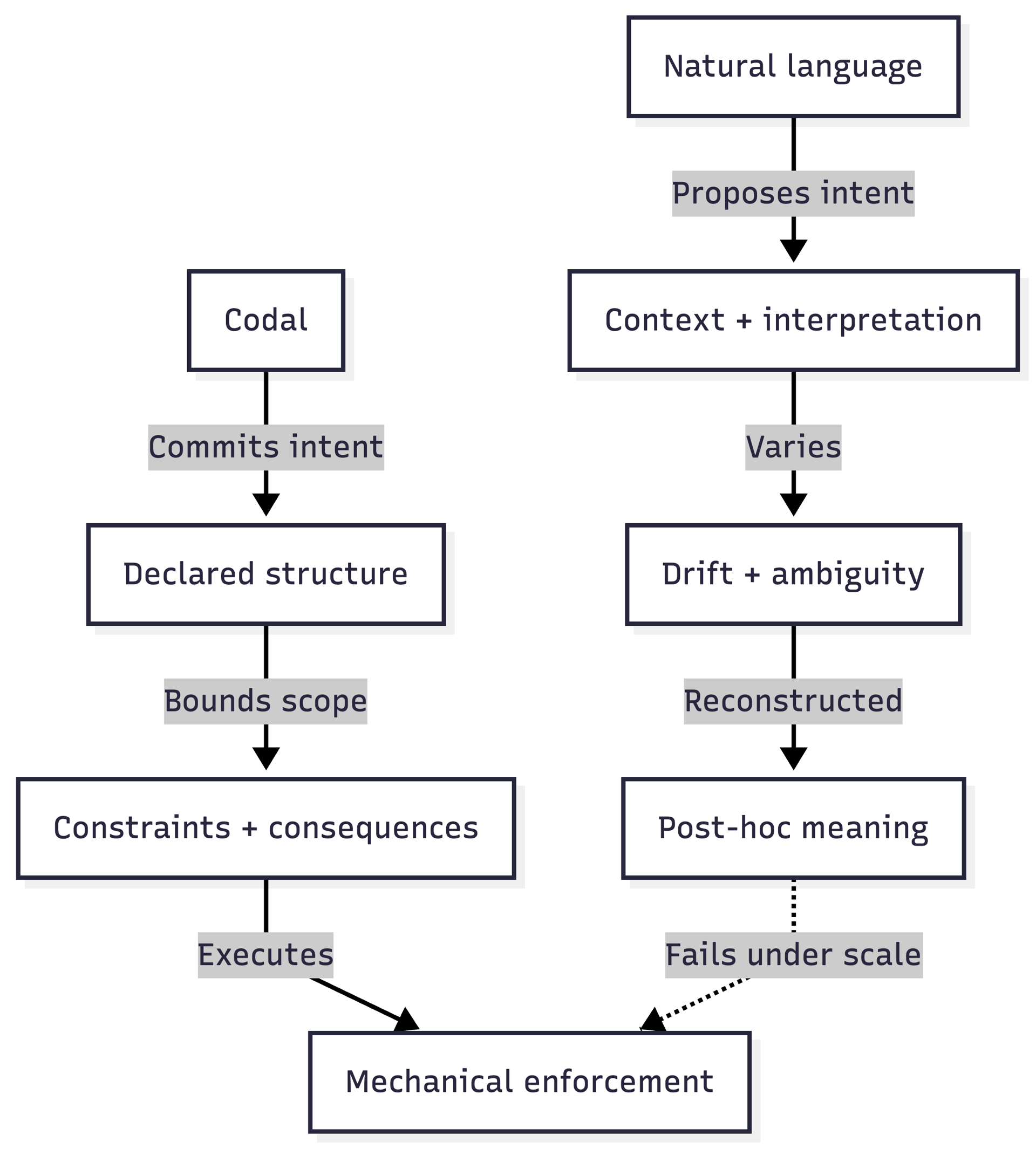
Specifications, prompts, policies, and requirements rely on natural language that must be interpreted after the fact. Meaning is inferred, scope is assumed, and constraints are enforced inconsistently, if at all.
As systems scale and execution accelerates, this gap becomes structural:
- Meaning drifts under iteration
- Intent is reconstructed after execution
- Constraints are enforced socially, not mechanically
- Failure emerges silently, downstream
Language as structure.
Codal treats language the way Hypermodern systems treat data: as something that must execute deterministically.
Instead of describing intent and hoping it is respected, Codal encodes meaning as structure. Scope is explicit. Constraints are bounded. What can happen, and what cannot, is mechanically determined.
There is no hidden context and no implied meaning.
How Codal works.
Codal turns intent into structure that systems can execute without interpretation.
Step 1 — Declarations
Meaning is declared, not implied. Every statement has a defined surface and scope.
Step 2 — Bounded expressions
All expressions are finite and constrained. Nothing executes outside what is explicitly permitted.
Step 3 — Explicit scope
Authority, applicability, and consequence are encoded directly, not inferred.
Step 4 — No implied meaning
If something is not stated, it does not exist.
Codal in the Hypermodern stack.
Vektagraf
Codal binds semantic intent to schema-level structure, ensuring meaning aligns with executable data.
PrivacyFirst
Codal encodes consent, scope, and authority as enforceable language, not policy.
Metaspace
Codal defines task meaning, commitment boundaries, and failure conditions without negotiation.
Terahertz
Codal structures become visible, navigable, and inspectable as spatial form.
What Codal is not.
Codal iss not:
Not a prompt language
Not a policy DSL
Not a markup or annotation format
Not interpretive
Not flexible by default
Flexibility without constraint is ambiguity.
Codal refuses ambiguity.
Where Codal is used.
Codal is used wherever intent must be explicit, bounded, and mechanically enforced.
Use cases:
- Binding AI intent to enforceable constraints
- Governance-grade specifications that execute
- Human–machine coordination without interpretation
- Constraint-safe automation and delegation
- Durable system contracts that do not drift
Why this matters now.
As AI systems accelerate execution, ambiguity compounds risk. Interpretation does not scale. Policies do not enforce themselves. Prompts cannot guarantee outcomes.
Language must stop being advisory.
When execution accelerates, language must stop being negotiable.
Codal and natural language.
As AI systems accelerate execution, ambiguity compounds risk.
Interpretation does not scale.
Policies do not enforce themselves.
Prompts cannot guarantee outcomes.
Typical use cases.
Examples:
- Exploring complex schemas and relationships
- Understanding why access was denied — structurally
- Identifying where validation pressure accumulates
- Investigating failure without replaying logs
- Teaching teams how their system actually works
No recommendations.
No automation.
Just visibility.
Current status.
Codal is specification-first and used internally across Hypermodern systems.
It is designed to be precise before it is convenient.