Where modern systems fail.
1. Privacy by policy
Most systems enforce privacy after the fact, through documents, training, and audits, rather than through execution itself. When rules are not enforced mechanically, privacy becomes aspirational.
2. Authority without proof
Modern infrastructure can explain what happened, but not why an action was legitimate at the moment it occurred. Authority is inferred, reconstructed, or assumed, never proven.
3. Surveillance as a substitute
When legitimacy cannot be proven, systems compensate by collecting more data. Surveillance becomes a substitute for authority, and privacy erodes as a side effect.
What PrivacyFirst is.
PrivacyFirst is decision infrastructure that encodes consent, authority, and proof as executable primitives; not inferred outcomes.
What PrivacyFirst Is Not
- an application layer
- a policy engine
- a workflow orchestration tool
- an IAM replacement
First principles.
These principles are not values or guidelines.
They are structural constraints. Each one defines a condition that must hold for privacy, consent, and authority to remain enforceable under automation, scale, and adversarial conditions.
Decisions are first-class
Outcomes are not evidence. Decisions are. PrivacyFirst treats decisions, not logs, roles, or narratives, as the primary object of authority.
Authority is bounded
All authority is constrained by scope, time, and consequence. There is no standing power, no silent escalation, and no authority that outlives its mandate.
Proof without exposure
Legitimacy does not require observation. PrivacyFirst enables systems to prove consent and authority without collecting, retaining, or exposing unnecessary data.
Execution consumes authority
Authority is evaluated at the moment of action, not reconstructed later. Execution is a consumer of proof, not a generator of narrative.
Privacy is a structural outcome
Privacy is not enforced through restraint or goodwill. It emerges when systems are unable to act without explicit, provable legitimacy.
Absence is a security property
The safest data is data that never exists. PrivacyFirst treats non-collection, non-retention, and non-replication as first-class guarantees, not optimizations or policies.
Executable authority.
This example shows authority as an explicit, bounded decision rather than an inferred permission. Presence is proven through a cryptographic challenge and signature, scope and expiry are encoded into the mandate itself, and execution is allowed only by presenting verifiable proof of legitimacy at the moment of action.
// PrivacyFirst (conceptual example): authority is a signed decision (a mandate).
// Execution is allowed only if the mandate is valid, bounded, and unexpired.
const mandate = await privacyFirst.mandates.propose({
decision: "transfer_funds",
resource: { accountId: "acct_123" },
choices: [{ id: "approve" }, { id: "reject" }],
constraints: {
maxAmount: 25000,
scope: "accounts:transfer",
expiresIn: "10m",
},
});
// A unique challenge is issued for this exact decision.
const challenge = await privacyFirst.mandates.challenge(mandate.id);
// Presence + intent: user verifies with a passkey and signs the challenge.
const signature = await passkeys.sign(challenge);
// The signed mandate is recorded immutably.
const proof = await privacyFirst.mandates.record(mandate.id, { signature });
// Only now can an external system execute, by presenting the proof.
await payments.executeTransfer({
accountId: "acct_123",
amount: 24000,
proof,
});
What PrivacyFirst refuses to do.
No silent authority
No standing permissions
No behavioral surveillance
No narrative audits
No data hoarding
No legitimacy by inference
These refusals are not limitations.
They are the guarantees.
The authority layer of the Hypermodern stack.
Data

Vektagraf
AUTHORITY

PrivacyFirst
Coordination

Metaspace
Authoritative systems fail when authority is symbolic.
Vektagraf establishes authoritative data: what exists and what has occurred.
PrivacyFirst establishes executable authority: who may act, when, and why.
Without authoritative data, authority becomes interpretive.
Without executable authority, privacy collapses into surveillance.
PrivacyFirst is not an overlay. It is the binding layer between truth and execution.
Foundations.
PrivacyFirst is not a policy framework or a compliance response. It is grounded in a body of written work that defines what legitimacy, consent, and authority must mean once systems act autonomously and at scale.
The Hypermodern Theorem formalizes the conditions under which authority can remain coherent when trust, discretion, and belief no longer scale.
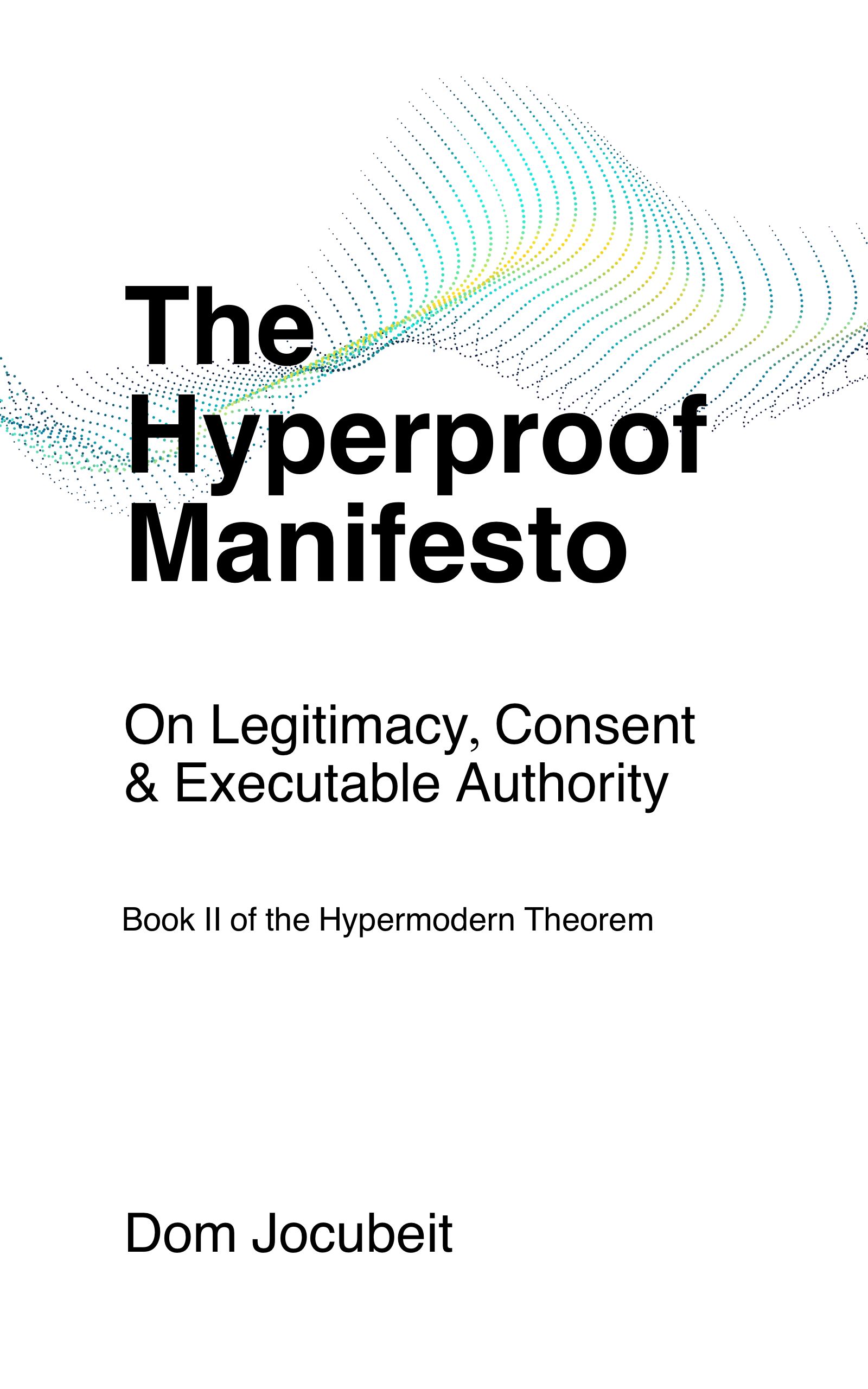
The Hyperproof Manifesto applies those constraints to authority and consent, defining what it would mean for legitimacy to be provable at the moment execution occurs.
For readers who want a slower introduction to the theorem, a weekly release of The Hypermodern Theorem is also available as a public publication.